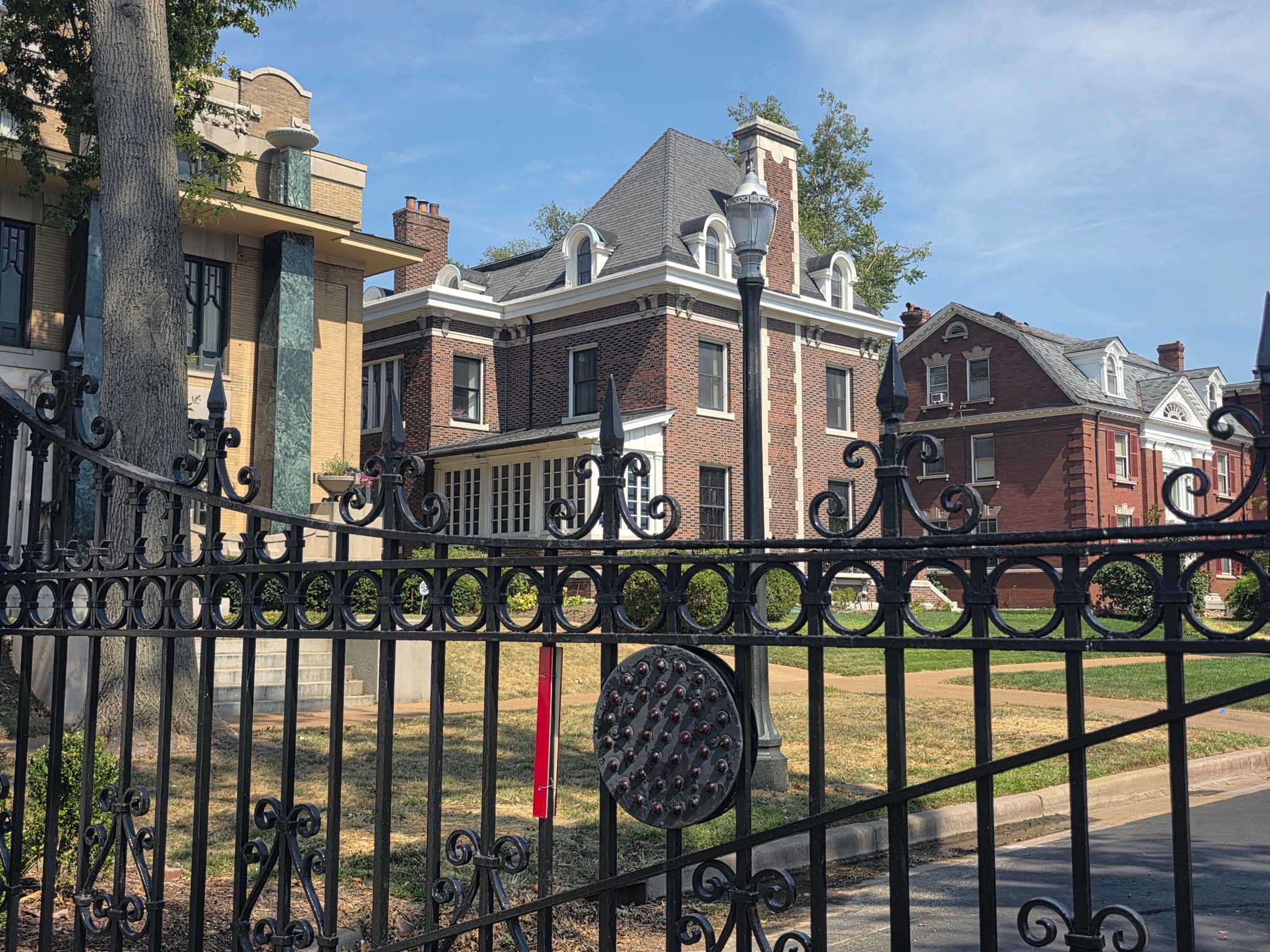
Stand at the corner of Lindell and Kingshighway and look east. The cathedral on your left is the Cathedral Basilica of Saint Louis, begun in 1907, with one of the largest collections of mosaics in the Western Hemisphere. The lamppost in front of you is an echo of a Gilded Age streetlamp that the city tore down decades ago. The mansions on your right belonged, once, to brewers and judges and railroad financiers — many of them still do.
This is the Central West End. And in 1900, when St. Louis was the fourth-largest city in the United States, this was where the city's money lived.
The Cities Within the City
Two streets, in particular, defined Gilded Age St. Louis: Portland Place and Westmoreland Place. They were among the first planned private residential parks in America, designed by surveyor Julius Pitzman in the late 19th century. Gated, deed-restricted, residents-only. You don't drive through. You're invited, or you're not.
The houses behind those gates were built during the strongest moment in St. Louis architecture — Beaux-Arts and Romanesque Revival and a few full-throated fantasies in between, all rising when limestone was cheap and labor was cheaper, and when a wealthy St. Louisan could reasonably expect his city to be the leading metropolis of the Mississippi Valley for the foreseeable future.
What St. Louis Was Building Toward
These weren't ego projects in isolation. They were built by people whose money was going into a city that, for a brief moment, looked like it would become the unrivaled capital of the American interior. The 1904 World's Fair drew nearly 20 million visitors to Forest Park, just south of these gates, and put the city on every European newspaper for a year. The Spirit of St. Louis (1927) was financed by a syndicate of St. Louisans who lived a few blocks from here.
The wealth that filled these houses came from brewing, banking, railroads, and shoe manufacturing — the industries that made St. Louis the country's fourth-largest city by 1900. The neighborhood was both a residential community and a statement: about confidence, about taste, about what the city believed it deserved to be.
The mansions are still here, the gates are still locked, and the stories are still spilling out.
Why Some of It Is Gone
Keep walking and you'll see something else: gaps. There was once an entire private street called Vandeventer Place, designed by the same Julius Pitzman, that stood east of where Portland Place is today. It was widely considered the grandest residential street in the city. The mansions came down one by one starting in the 1940s, and the land became something else.
What did happen at roughly the same moment, a couple of miles south of here, was the Mill Creek Valley clearance — the largest urban-renewal demolition in St. Louis history. Approximately 20,000 people were displaced and roughly thirty blocks of homes, businesses, and churches — overwhelmingly Black-owned and Black-attended — were leveled in the late 1950s. The Central West End survived where Mill Creek Valley didn't. Some of that survival was wealth and connections. Some of it was the gates.
The same restrictive infrastructure that kept the wrong people out also, in the long run, kept the buildings up.
That sentence is the whole tour, more or less. The Gilded Age in the Central West End is a beautiful neighborhood and a complicated inheritance, both at once. We don't tell that story to be uncomfortable. We tell it because pretending the houses just happen to be there would mean missing the most interesting thing about them.
What Still Stands
The Central West End is the only neighborhood in Missouri listed among the "Great Places of America" by the American Planning Association. The Cathedral Basilica of Saint Louis at Lindell and Newstead, begun in 1907, holds one of the largest collections of mosaics in the Western Hemisphere — open to the public, worth an hour at minimum. The candelabra streetlamps lining Maryland Plaza are an echo of the Gilded Age streetlamp that used to anchor the Kingshighway and Lindell intersection. The Holy Corners district at Kingshighway and Westminster — three churches and a club, all built in the early 20th century — is on the National Register and is one of the densest concentrations of Gilded Age civic architecture in the city.
You can walk past Portland Place and Westmoreland Place. You can see the gates. You can read the names on the gateposts. What you can't do is walk in.
That's what the tour is for.
The Tour That Tells Stories Like This One
On the Eat Like a Lou-natic food + history walking tour, we walk past Portland Place, the cathedral, the Maryland Plaza lamps, and the places where St. Louis chose what to keep and what to lose — all while eating very well. Three hours. Two miles. Thursday through Saturday.
Book the Food Tour →